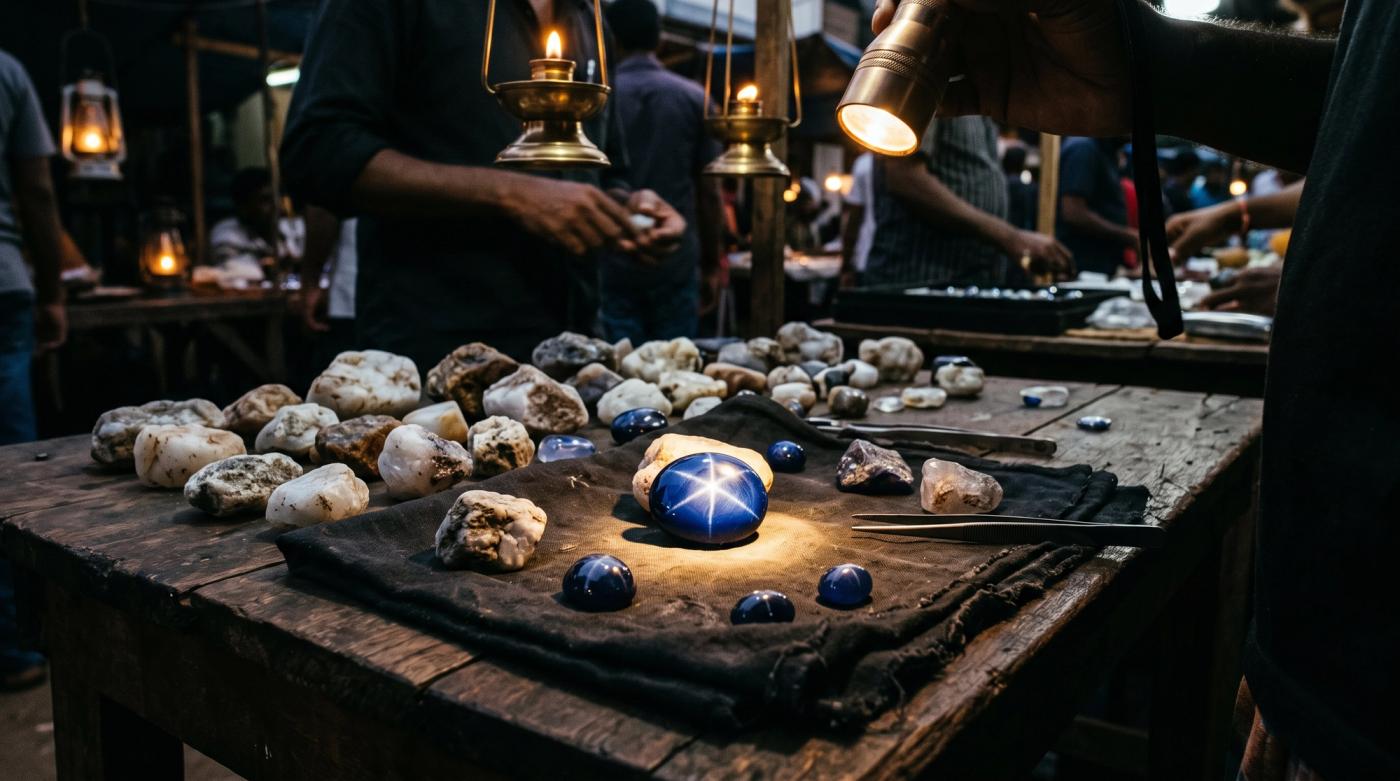
The first time I cut a star sapphire, I nearly threw the rough back in the parcel. It was a dull, milky grey-blue lump — the kind of stone I'd normally reject at the market because it's too cloudy to facet. Held up to the light it looked half-dead. But I tilted it, put a single torch on it, and a faint line of light swam across the surface. That "flaw" was the whole point. Cut right, that cloudiness becomes a star.
That contradiction sits at the heart of every question people ask me about star sapphire gemstones — especially the big one: why are they so cheap? The short answer is that the same thing that makes a normal sapphire cheap is exactly what makes a star sapphire work. Let me walk you through it from the wheel.
What is a star sapphire gemstone, in plain terms
A star sapphire is a real sapphire — same mineral, corundum — that shows a star of light across its dome when you shine a single light on it. The star is usually six rays, sometimes twelve in rare stones. Move the light or turn the stone, and the star glides with it.
That's the whole trick. It's not painted on, not set into the stone. The star lives inside the crystal.
Two things have to be true for a star sapphire gemstone to show its star:
- The stone has to hold the right internal structure (I'll explain the "silk" below).
- It has to be cut as a cabochon — a smooth, rounded dome — not faceted. Facets would kill the effect.
So yes, a star sapphire is 100% a genuine sapphire. It's just a sapphire that's been read differently by whoever cut it. Most search traffic here is for the blue star sapphire, but the same stones turn up grey, black, pink, purple, even a soft golden.
What actually causes the star: asterism
The effect has a proper name — asterism. And the cause is the part almost nobody explains clearly, so here's what I actually see under the loupe.
Inside the corundum are millions of microscopic needles. In most Ceylon star sapphires these needles are rutile — a titanium mineral. Gem cutters call this cloud of needles silk, because that's exactly what it looks like: a soft, silky sheen inside the stone, like light catching a spider web.
Here's the important bit. Those needles don't grow randomly. Corundum has a trigonal crystal structure (part of the hexagonal crystal family), and the rutile needles line up along that structure in three directions, each set crossing the others. When you cut a dome over the top and shine one light, each set of needles reflects that light back as a single bright band. Three sets of needles, three bands of light, crossing at the centre — that's your six-ray star.
That's also why the cut matters so much. The dome of the cabochon has to sit square over the axis of the crystal, or the star sits off-centre, or splits, or wanders off the top. When I'm grinding a star rough I'm not chasing clarity at all — I'm hunting for the exact orientation where all three bands meet in the middle. Get it a few degrees wrong and a good star becomes a mediocre one. This is a completely different job from faceting.
For the record, this is a sapphire asterism — the same phenomenon shows up in star rubies (red corundum) and, more rarely, in other minerals too.
Why are star sapphires so cheap?
Now the honest answer, and the one page after page online dances around.
In a normal sapphire — a clean blue faceted stone — silk is a defect. Those rutile needles cloud the stone, scatter the light, and drop the clarity. When I'm picking through rough to facet, a stone full of silk is a cheap stone. Buyers pay for transparency. The trade rule for faceted sapphire is simple: eye-clean and vividly coloured equals valuable; cloudy equals cheap.
A star sapphire breaks that rule completely. The very silk that would ruin a faceted stone is the thing that creates the star. So star sapphires get graded on a different scale entirely — not "how clean is it" but:
- How sharp and complete is the star?
- How good is the body colour?
- Is the cabochon cut symmetrical, with the star centred?
Because the raw material — silky, included corundum — is the cheaper end of what comes out of the ground, most star sapphires end up cheaper per carat than a fine faceted sapphire of the same size. There's simply a lot more silky rough than clean rough. A translucent grey star with a soft, blurry line can cost very little.
That's the real reason. Not because they're fake, not because they're low quality — but because they're cut from material that the faceting trade prices low, and priced on a scale where "included" is the whole point.
So when someone asks me are star sapphires valuable, my honest reply is: most aren't expensive — but a genuinely fine one absolutely is.
When a star sapphire is NOT cheap
Here's the other side, because "cheap" is only half the story.
A top star sapphire is rare and can be very expensive. What flips it from cheap to serious money:
- A razor-sharp, complete star — all rays straight, unbroken, meeting cleanly in the centre. Most stars are soft or blurry. A crisp one is uncommon.
- Strong, saturated body colour — a rich blue with a clear star is far rarer than a grey one. This is where blue star sapphire value climbs fast.
- Good translucency — a stone that glows rather than sitting dead and opaque.
- Size — big clean stars are scarce, and price per carat climbs with weight.
- Rare colours — a fine pink or padparadscha-toned star is unusual.
The famous stones live at this extreme. The Star of India, around 563 carats, is one of the best known star sapphires in the world — and it's Ceylon in origin, mined in Sri Lanka. When people picture a great star sapphire, they're often picturing a Sri Lankan stone whether they know it or not.
Sri Lanka's role in star sapphire
This is where I get to talk about home.
Sri Lanka — Ceylon — is one of the world's great sources of star sapphire. The alluvial gravels here, what we call illam, sit in the ground around Ratnapura and the surrounding gem fields, and they've been producing sapphires for a very long time. A lot of the silky, translucent material that makes good stars comes out of these deposits.
When I'm at the market in Ratnapura going through a parcel of rough, the silky stones — the ones a faceter passes over — are exactly the ones I'm turning over in my hand for star potential. I hold each one to a single light and rock it, looking for that swimming line. Most give nothing. Every so often one shows a clean cross, and that's the one I take home to cut.
If you want the fuller background on why Ceylon stones are so respected, I've written that up separately in what is a Ceylon sapphire. Everything I sell is natural, Sri Lankan, cut and polished by hand, and labelled honestly — you can see the current stones on the sapphire page.
How to spot a fake or treated star sapphire
Plenty of "star sapphires" out there aren't natural stars. Some are synthetic (lab-grown corundum with induced silk — historically branded "Linde stars" by Union Carbide starting in 1947, a name still used loosely in the trade for synthetic star corundum), some are glass, some are natural sapphires with treatments. Here's what I actually check.
The star should be a little imperfect. This sounds backwards, but a real star is usually slightly wavy, and the rays aren't all perfectly even. A star that is textbook-perfect — dead straight, razor rays, sitting on a suspiciously clean transparent stone — is often synthetic. Natural silk is never that tidy.
Look at where the star sits. On a natural stone the star should be inside the dome, floating a touch below the surface as you rock it. On some fakes the star looks painted right on top.
Check the base. Assembled or backed stones sometimes have a mirror or foil under the cabochon to fake the effect. Turn it over. A natural star sapphire is a single stone through and through, often with a slightly rough or unpolished base.
Use one light, not many. Overhead shop lighting with lots of bulbs makes almost anything sparkle. A real star needs a single point source — the sun, or one torch. Multiple lights give multiple weak stars and hide the truth. This is the simplest test a buyer can do on the spot: take it to a window or use your phone torch.
Watch for glass filling. Glass/fracture-filling is more commonly seen in low-grade ruby, but it does turn up in sapphire too, including star material. Under a loupe you can sometimes see gas bubbles or a different lustre in the filled areas. If in doubt, ask for a lab report.
None of these are foolproof on their own, but together they'll catch most of the obvious fakes.
What to look for when buying
If you're shopping for a natural star sapphire ring or a loose stone, here's the order I'd rank things in — same order I use when I decide what's worth cutting.
- Star sharpness first. A clear, centred star beats everything. A blurry star on a nice colour is still a blurry star.
- Ray count and completeness. Six full rays is the standard. Rare stones show twelve. Broken or partial rays drop the value.
- Body colour. Blue is the most sought after; a good even colour lifts the whole stone. Grey and black stars are common and inexpensive.
- Cut symmetry. The dome should be even and the star centred when you look straight down. An off-centre star means the cutter compromised.
- Carat weight. Bigger costs more per carat, but only if the star holds up at size.
- Treatment and origin. Ask whether it's heated or unheated. Star sapphires are heated less often than faceted ones — strong heat can dissolve the very silk that makes the star — but always ask. I explain the difference in heated vs unheated sapphire.
Buy the star, not the size. A small stone with a clean crisp star will always look better on a hand than a big dull one.
You can see what I currently have cut and ready on the sapphire category page.
FAQ
Is star sapphire a real sapphire?
Yes. It's the same mineral as any sapphire — corundum. The only difference is that it contains fine needle inclusions (silk) that create a star, and it's cut as a rounded cabochon instead of being faceted. It is a genuine, natural sapphire, not an imitation.
Do star sapphires have any value?
They do, but the range is wide. Common grey or black stars with a soft star are inexpensive. Fine stones — a sharp, complete star on a strong blue body, well cut and of good size — are rare and can be genuinely valuable. Value here is judged on the quality of the star and colour, not on clarity the way faceted sapphires are.
Why are star sapphires so cheap?
Because they're cut from silky, included corundum — the same cloudy material that the faceting trade prices low, since silk ruins clarity in a transparent stone. In a star sapphire that silk is essential, so these stones are graded on the star and colour rather than clarity. There's far more silky rough than clean rough, so most star sapphires cost less per carat than fine faceted sapphires. Fine stars are the exception and are not cheap at all.
How expensive is a star sapphire?
It spans a huge range. A small translucent star with a soft line can be very affordable. A large stone with a crisp, centred six-ray star on a saturated blue body climbs steeply in price per carat, and the world-famous examples are effectively priceless museum pieces. Price tracks star sharpness, body colour, size and cut symmetry.
What does the "star" in star sapphire mean?
It refers to asterism — the star-shaped figure of light that floats across the stone under a single light source. It's caused by light reflecting off three sets of microscopic needle inclusions inside the crystal, which is why the standard star has six rays.
---
I'll be straight with you: most star sapphires are affordable because they're made from material the faceting world doesn't want. That's not a knock on them — it's the reason they exist, and honestly it's why I love cutting them. A stone nobody else saw value in, turned so the light finally catches its star.
What I'd tell a friend: don't overpay chasing size or a "perfect" star. Take any star sapphire to a single light, rock it slowly, and buy the one whose star stays sharp and centred as it moves. That one small test tells you more than any price tag.
Comments
Be the first to leave a comment.
Thanks — your comment is in and will appear once we've approved it.