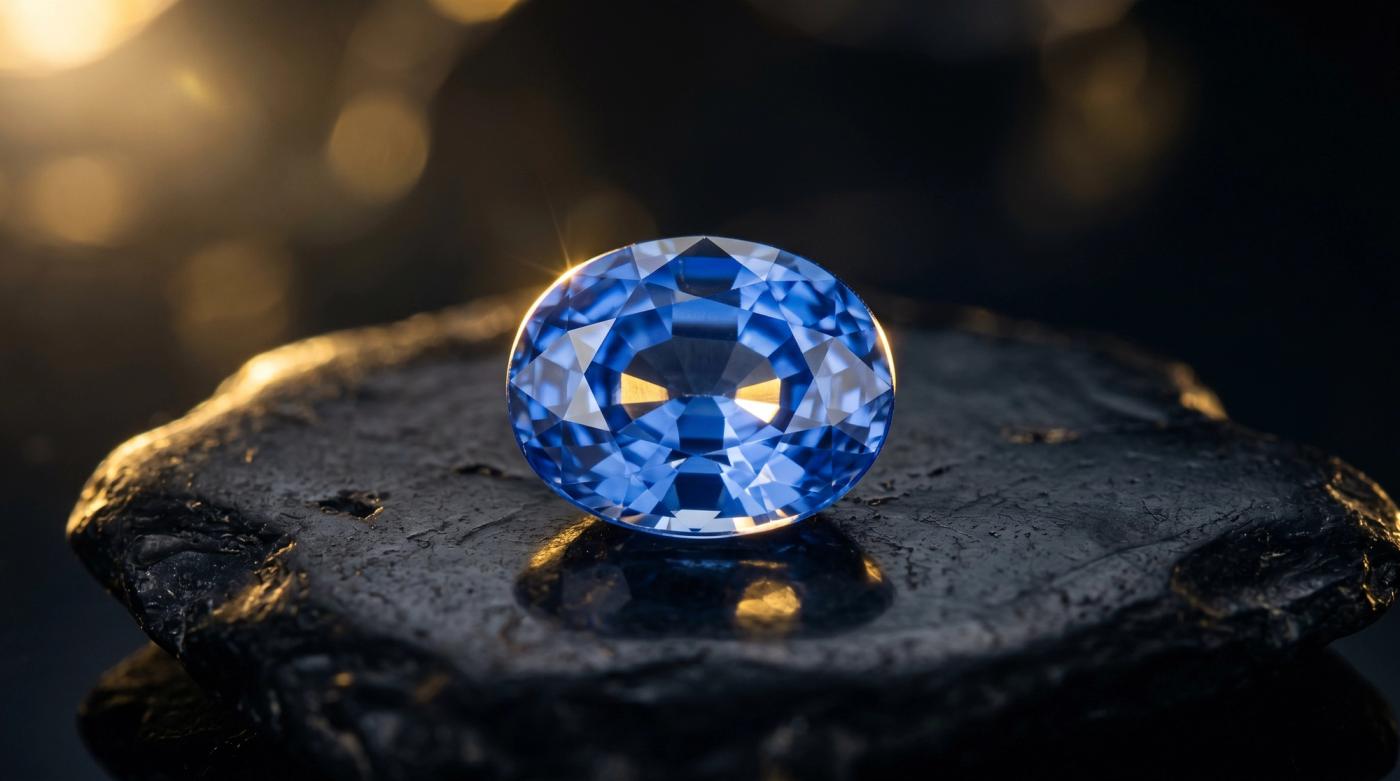
I buy rough sapphire at the markets in Ratnapura and Beruwala, then cut and polish the stones by hand. So when someone asks me what makes a Ceylon sapphire different from any other sapphire, I'm not answering from a textbook. I'm answering from years of holding both in my fingers under the same light.
The short version: all sapphire is the same mineral. But where a stone grows changes how it looks, and Sri Lankan ground tends to produce some of the brightest, cleanest blue you'll find anywhere. That's why a Ceylon stone usually behaves differently on the cutting wheel, and why it sells for what it does.
Here's the longer version, the honest one.
What "Ceylon Sapphire" Actually Means
Ceylon is the old colonial name for Sri Lanka. The country was called Ceylon until 1972, but in the gem trade the name stuck, the way "Burma" stuck for rubies. So "Ceylon sapphire" doesn't mean a special species of stone. It's an origin term. It tells you where the stone came out of the ground — Sri Lanka — and nothing more about the mineral itself.
Because here's the thing people get wrong: every sapphire on earth is the same mineral, corundum. Corundum is crystalline aluminium oxide. When traces of chromium turn it red, we call it ruby. Every other colour of gem-quality corundum — blue, yellow, pink, white, the lot — we call sapphire.
So a "Ceylon sapphire" and an "ordinary sapphire" are the same mineral. The difference is the address. And in gemstones, address matters, because the geology that grew the crystal leaves its fingerprint in the colour, the clarity, and the way the stone takes light.
Where Ceylon Sapphires Come From
Sri Lanka has been a gem island for over two thousand years. Old Arab and Persian traders wrote about it. The local name for the country is Ratnadeepa — "island of gems." The town I buy from most, Ratnapura, means "city of gems."
Most Sri Lankan sapphire is mined from alluvial gravels — what local miners call illam. These are old riverbed and gravel layers where stones have weathered out of the original rock over millions of years and collected in pockets underground. Miners sink pits and wash the gravel by hand in cone-shaped baskets to concentrate the heavy gem material. It's slow, wet, hard work, and most of it is still done the traditional way.
That alluvial origin matters. Because the crystals have been tumbled and sorted by water and time, the survivors tend to be tough, clean material. When I'm picking through a parcel of rough at the market, the Sri Lankan stones often come up with fewer fractures and good transparency. That's part of why so many end up cut rather than thrown back.
Why Ceylon Sapphires Are Prized
Three things, mostly: the colour, the brightness, and the range.
The blue is lighter and livelier
Sapphire from some other sources runs dark — so dark it can look inky or almost black in poor light, and you have to tilt it to the window to see any blue at all. Ceylon blue tends to sit lighter and brighter: cornflower blues, soft "sky" blues, medium royal blues that still glow under normal indoor light. That liveliness is the thing buyers respond to, even if they can't name it.
A lot of this comes down to how the stone returns light. Cleaner material with the right colour saturation just looks more alive in the hand. When I finish polishing a good Ceylon blue, it lights up across the whole face. A darker, over-saturated stone can look heavy and dead by comparison.
The Ceylon Sapphire Colour Range (It's Not Only Blue)
This is the part casual buyers don't expect. Sri Lanka produces sapphire in a whole spread of colours:
- Blue — the classic, from pale to rich royal
- Yellow — from light lemon to warm golden
- Pink — soft baby pink to hot pink
- White / colourless — near-transparent stones
- Padparadscha — a rare pink-orange colour, named from a Sinhalese/Sanskrit word (padmaraga) meaning the colour of the lotus blossom. Sri Lanka is the classic source for it.
So a simple Ceylon sapphire colour chart isn't one colour. It's a fan. That range is one of the reasons collectors take the origin seriously.
Ceylon vs Other-Origin Sapphire
To be fair about it — Ceylon is excellent, but it isn't automatically "the best." Origin sets a general character; the individual stone still decides everything.
- Sri Lanka (Ceylon) — Bright, often lighter blues; wide colour range; usually good clarity
- Madagascar — Can closely resemble Ceylon; large modern source of fine blue
- Australia / Thailand — Higher iron content, often darker and more saturated, can read inky
- Kashmir — Famously prized "velvety" cornflower blue; extremely rare, top of the market
- Burma (Myanmar) — Rich, deep "royal" blue; historically very prized
Bottom line: origin sets the character, but the individual stone sets the price.
At the very top of the auction world, Kashmir sapphire is usually the most celebrated and commands the highest prices, with fine Burmese stones close behind. Those are scarce, historic sources. Ceylon sits firmly in the fine category and is far more available, which is part of why it's the origin most people actually end up buying and wearing.
So the honest answer to "what is the highest-quality sapphire?": there's no single origin that wins by default. The finest individual stones — top colour, high clarity, good cut, and ideally no heat treatment — are what command the highest value, whatever the origin. Kashmir and Burma carry the biggest auction names; Ceylon delivers superb stones you can realistically own.
What Actually Drives the Value
When a buyer asks me about Ceylon sapphire value, I bring it back to the same factors every time. The four Cs apply to sapphire just like diamonds, plus one more that's specific to coloured stones.
- Colour — the single biggest driver. Strong, even, attractive colour with good saturation (not too dark, not washed out) wins.
- Clarity — fewer visible inclusions, better transparency.
- Cut — how well it's faceted. A good cut wakes the colour up; a lazy cut kills it. This is the part I control on the wheel.
- Carat — bigger stones are rarer, so price per carat climbs as size goes up.
- Treatment — heated vs unheated. This one deserves its own honest paragraph.
Heated vs unheated — the honest bit
The large majority of sapphire on the market has been heat-treated. Heating is an old, accepted practice: you take a stone to high temperature to improve or stabilise its colour and clarity. It's permanent and it's not a scam — but it must be disclosed.
An unheated stone with genuinely fine natural colour is rarer, and a fine unheated Ceylon stone with a lab report to prove it sells for a real premium over a heated one.
I sell both. What I won't do is hide it. Every stone we sell is labelled heated or unheated plainly, so you know exactly what you're paying for. If a seller won't tell you the treatment, that itself tells you something.
How to Tell if a Sapphire Is Really Ceylon
This is where I have to be straight with you: you cannot reliably confirm origin by eye, and neither can most dealers. Stones from Sri Lanka and Madagascar in particular can look almost identical. Anyone who glances at a loose stone and instantly "guarantees" the country is guessing.
Origin is determined in a gemmological laboratory. Trained gemmologists study the stone's inclusions, trace elements and growth features under magnification and with instruments, then issue a report stating the likely origin and whether the stone shows heat treatment.
The labs whose reports carry real weight in the trade:
- GIA (Gemological Institute of America)
- SSEF (Swiss Gemmological Institute)
- Gübelin (Gem Lab, Switzerland)
- AGL (American Gemological Laboratories)
For an important or expensive sapphire, an origin report from one of these is what separates a confident purchase from a hopeful one. For everyday stones, what matters most is buying from someone who knows the material, sources it themselves, and tells you the truth about colour, treatment, and origin.
Tough Enough to Wear Every Day
One more reason sapphire earns its place in jewellery you actually wear: hardness. Corundum sits at 9 on the Mohs hardness scale, second only to diamond among natural minerals. That's why a sapphire ring shrugs off the knocks of daily life in a way softer stones can't. A Ceylon sapphire isn't just beautiful — it lasts.
The Most Famous Blue Sapphire of All
If you've ever wondered why the world fixed on blue sapphire, look at the most famous engagement ring on the planet. The 12-carat oval blue sapphire ring Prince Charles gave Diana in 1981 — chosen from a Garrard catalogue, and now worn by Catherine, Princess of Wales — is often described as a Ceylon sapphire, though its exact origin has never been confirmed by a gem lab. Either way, that deep cornflower blue surrounded by diamonds is the picture most people carry in their head when they think "sapphire" — and it's exactly the look Ceylon stones are known for.
So, Are Ceylon Sapphires Rare and Worth It?
Rare is the wrong word for the category — Sri Lanka is a productive source and you can readily buy Ceylon sapphire. Fine Ceylon sapphire is another matter. The genuinely top stones — excellent colour, clean, well cut, and especially unheated with a report — are scarce and hold their value well.
For most buyers, that's the sweet spot of the whole gem world: a stone with real history, beautiful colour, and proven toughness, that you can actually afford to own and wear.
Buying a Ceylon Sapphire: What I'd Tell a Friend
If you take nothing else from this, take these four habits. They'll save you from most bad buys:
- Ask the treatment, every time. Heated or unheated — a straight seller will tell you without flinching. A vague answer is your answer.
- Look at the stone in different light. Daylight, shade, indoor bulbs. A good Ceylon blue stays alive across all of them; a stone that only looks good under the shop's spotlight is hiding something.
- For a serious stone, get a lab report. Origin and treatment from GIA, SSEF, Gübelin or AGL. It's the difference between knowing and hoping.
- Buy from someone who actually handles the material. A cutter or direct sourcer has seen the stone as rough, knows where it came from, and has no middleman to hide behind.
That last point is really why I sell the way I do. When you buy direct from the person who cut the stone, you're not paying for three layers of markup, and you can ask the awkward questions and get a real answer.
A Word About What I Sell
Everything we cut at Grand Facets is natural Ceylon material, sourced in Sri Lanka and finished by hand here. Our sapphires come in the full Ceylon range, and every single stone is labelled heated or unheated, with origin stated plainly. If sapphire isn't the stone for you, the same goes for our spinel, garnet and chrysoberyl.
I'd rather you understood what you were buying and bought one good stone than chased a bargain that turns out to be something it wasn't. That's the whole reason I wrote this.
Comments
Be the first to leave a comment.
Thanks — your comment is in and will appear once we've approved it.