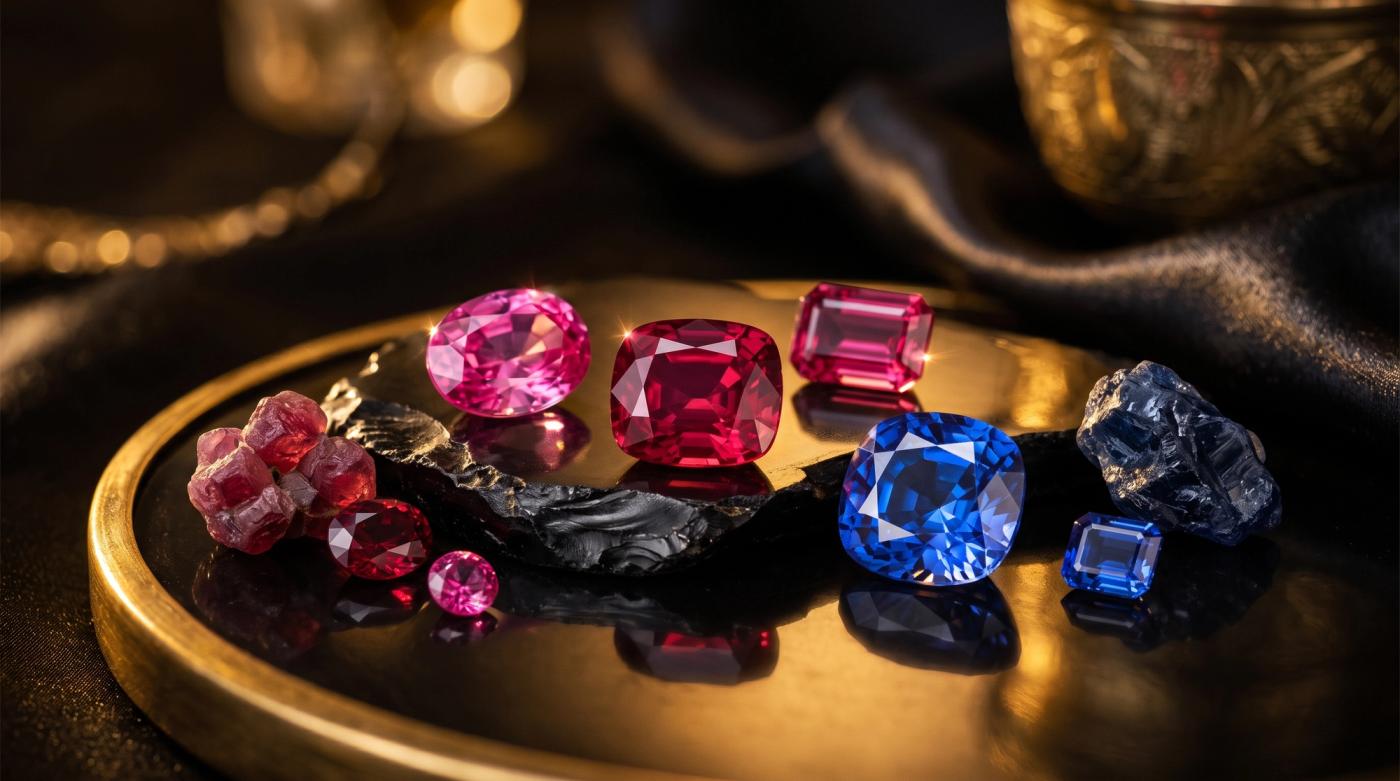
Most weeks I'm down at the gem market, sitting on a low stool with a parcel of rough tipped out onto a white paper in front of me. Sapphire is what everyone reaches for. But every so often a few small, glassy, octagonal-looking crystals turn up in the mix — sharp little eight-sided shapes, often a deep raspberry red or a soft greyish blue. The seller usually undervalues them. That's spinel. And for the buyer who knows what he's looking at, it's one of the best-kept secrets in the trade.
I've cut a lot of spinel by hand over the years, and I want to tell you what it actually is — not the textbook version, but what it looks like on the paper, on the wheel, and in the finished stone.
What Is Spinel Gemstone?
So, what is spinel gemstone in plain terms? Spinel is a natural gem mineral — magnesium aluminium oxide, with the chemical formula MgAl₂O₄. It forms in the cubic crystal system, which is why those rough crystals show up as such clean octahedrons. It's a single mineral in its own right, completely separate from ruby and sapphire, even though for centuries people couldn't tell them apart.
Here are the quick facts a dealer keeps in his head:
- Chemical formula: MgAl₂O₄ (magnesium aluminium oxide)
- Crystal system: Cubic (isometric)
- Mohs hardness: 8
- Refractive index: about 1.712 to 1.736
- Optical character: singly refractive (no double refraction, no pleochroism)
- Lustre: vitreous — that bright, glassy shine
That last point matters more than it sounds. Because spinel is singly refractive and has no pleochroism, the colour you see is the colour you get from every angle. Sapphire shifts and winks as you turn it; spinel just sits there glowing one steady colour. When I'm cutting, that's a gift — I don't have to chase a colour direction the way I do with corundum.
The other thing I'll say up front: spinel gemstone is one of the cleanest things you can cut. Most good spinel comes out of the ground with very few inclusions. On the polishing wheel it takes an edge beautifully and the facets meet crisp and sharp. It's an honest stone to work.
A Gemstone That Fooled Royalty for Centuries
Here's the story every spinel lover tells, and it's a true one. For hundreds of years, no one separated red spinel from ruby. Both turn up red, both come out of the same gravels in Sri Lanka and Burma, and before modern gemology there was no way to tell them apart. They were all just called "ruby."
The most famous example is the Black Prince's Ruby, set in the front of the Imperial State Crown of the British Crown Jewels. For centuries it was treasured as a giant ruby. It's actually a large red spinel — a fact only understood much later, once gemology could measure the differences between the two minerals. The Timur Ruby, another famous "ruby" associated with the British royal collection, is also a spinel.
I love this history because it tells you something real: spinel was never a cheap imitation. For 500 years it sat in the crowns of kings and was loved as much as any ruby. The trade only "demoted" it once we had the tools to name it correctly. The stone itself never changed.
Where Does Spinel Come From? Why Ceylon Spinel Is Different
Spinel comes from a handful of places, and the source really does change the character of the stone.
- Sri Lanka (Ceylon): Our spinel comes out of the same alluvial gravel — the illam — that produces Ceylon sapphire. Ratnapura, Elahera, and the surrounding belts give a wide colour range: hot pinks, reds, lavenders, soft blues, greys. Ceylon spinel tends to be bright and clean, with that glassy life I keep talking about.
- Myanmar (Mogok): The Mogok valley in Burma is famous for the most intense red spinel. The term "jedi" — a trade name coined by GIA field gemologist Vincent Pardieu — applies specifically to the neon hot-pink to vivid pinkish-red material from the Man Sin (Namya) deposit within the Mogok region. Those, and Mogok's classic deep reds, are among the stones the high-end market chases hardest.
- Tanzania (Mahenge): The Mahenge deposit produced an electric, almost neon hot-pink spinel that shook up the market when it came out. Vivid, saturated, unforgettable.
I buy local, so I work mostly with Ceylon material. What I love about it is the variety on a single paper — I might pull a raspberry red, a steely cobalt-leaning blue, and a delicate lavender out of the same parcel. Sri Lanka has been digging gems out of these gravels for over two thousand years, and spinel has always been part of what comes up alongside the sapphire.
When I'm picking through rough, spinel gives itself away by its shape and its clarity. Those octahedral crystals are unmistakable once you've seen a few, and they're usually so clean you can almost read the colour straight through the skin.
Spinel Colors: The Full Spectrum
People ask me about spinel gemstone colors more than almost anything, because the range surprises them. This isn't a one-colour stone.
Red Spinel
Red is the king. Red spinel gemstone gets its colour from chromium — the same element that colours ruby red — which is exactly why the two were confused for so long. The finest reds are pure, slightly warm, and glow from within. A fine red spinel is genuinely rare, and the price reflects that.
Pink and Hot Pink
Pinks run from soft, romantic rose tones up to the searing hot pinks of Mahenge and Mogok. These are some of the most desirable spinels on the market right now, and to my eye they're some of the prettiest stones in any gem family.
Blue Spinel
Blue spinel gemstone is the one people don't expect. Blue spinel coloured by cobalt is intensely saturated, vivid, and very scarce — true cobalt-blue spinel is one of the rarest and most valuable colours in the whole species. More common blue spinel is coloured by iron and tends toward a greyer, steelier blue. I've cut a few of the greyish-blue Ceylon stones; they have a quiet, smoky elegance that grows on you.
Lavender, Purple, Grey, and Black
Spinel also comes in lavender and purple, soft greys, and an opaque black (black spinel, often cut into beads). There are even rare colour-change spinels that shift from a bluish or greyish tone in daylight to a purplish or reddish tone under warm light.
If you want to see the spread for yourself, this is the range I keep in stock as Ceylon spinel — it tells the colour story better than any chart.
Is Spinel a Real Gemstone? Precious or Semiprecious?
I get asked this a lot, usually nervously: is spinel a real gemstone? Yes. One hundred percent. Spinel is a completely natural gem mineral, mined out of the ground, no different in legitimacy from sapphire or emerald. The confusion comes from two places: the name sounds unfamiliar to people, and there's also a lab-grown synthetic spinel that's been used in cheap jewellery for decades. But natural spinel is the real thing, and it has been treasured for over a thousand years.
The "precious versus semiprecious" question is messier. The old trade tradition named only four "precious" stones — diamond, ruby, sapphire, and emerald — and lumped everything else under "semiprecious." That system is outdated and honestly not very useful. A fine red spinel can outvalue a mediocre ruby easily. People talk about the Big 3 coloured stones (ruby, sapphire, emerald); spinel deserves to be the overlooked fourth, and a lot of serious collectors already treat it that way.
So if a label calls spinel "semiprecious," don't read that as "cheap." Read it as "underpriced for what it is."
How Much Is Spinel Worth? Spinel Price by Color and Carat
Now the practical question: spinel gemstone price. I'll be straight with you, because pricing depends heavily on colour, size, and clarity, and anyone giving you one flat number is guessing.
What drives the price:
- Colour first, always. Vivid red and electric hot pink sit at the top. Cobalt blue is right up there too. Greys, soft lavenders, and pale stones cost much less.
- Size. Spinel above a few carats in a top colour gets rare fast, and price per carat climbs steeply with size.
- Clarity and cut. Spinel is usually clean, so the market expects clean. A well-cut stone that returns light evenly is worth a real premium over a flat, windowed one.
- Origin. Mogok and Mahenge names carry weight at the top end.
As a rough guide, commercial grey or pale spinel can be quite affordable per carat, mid-grade pinks and reds sit in the middle, and fine vivid red, hot pink, or cobalt blue can run into the thousands of dollars per carat at the very top. Those high-end figures are a flag to verify — the market moves, and I'd rather you check current numbers than take an old price as gospel.
Here's what I'd tell a friend: spinel still offers more colour-per-dollar than almost anything else in the coloured-stone world. You're buying a stone that fooled kings, at a fraction of what the "named" stones cost. When you're ready to look at actual cut stones with their full details listed, the Grand Facets shop is where I put mine up.
Spinel vs Ruby and Spinel vs Sapphire
This is the comparison that matters most, since these three minerals turn up side by side in the same Sri Lankan gravels. Ruby and sapphire are both corundum (aluminium oxide); spinel is its own mineral entirely. Here's how they line up:
- Mineral. Spinel is magnesium aluminium oxide (MgAl₂O₄); ruby and sapphire are both corundum (Al₂O₃).
- Mohs hardness. Spinel is 8; ruby and sapphire are 9.
- Refractive index. Spinel reads ~1.712–1.736; ruby and sapphire read ~1.762–1.770.
- Refraction. Spinel is singly refractive; ruby and sapphire are doubly refractive.
- Pleochroism. Spinel has none; ruby is strong; sapphire is moderate to strong.
- Treatment. Spinel is usually untreated; ruby and sapphire are very often heated.
- Relative price (fine quality). Spinel sits below ruby and fine sapphire; ruby is the highest, sapphire high.
A few practical notes from the bench:
- Hardness. Ruby and sapphire are harder (Mohs 9) than spinel (Mohs 8), but 8 is still very hard and plenty durable for daily-wear jewellery.
- The treatment edge. This is the big one in spinel's favour. Most ruby and sapphire on the market is heat-treated. The vast majority of natural spinel is not treated at all — what comes out of the ground is what you get. To me that's a major selling point, and it's part of why I'm happy to put my name to it.
- Telling them apart. Under a loupe, ruby and sapphire show double refraction and pleochroism — the colour shifts as you turn them. Spinel stays one steady colour and shows no doubling. A gemologist confirms it in seconds with a refractometer; spinel reads a single number, corundum reads two.
Which is better, sapphire or spinel? Wrong question, really. Sapphire has the name, the history, and the market depth. Spinel gives you comparable beauty, single-refractive glow, usually no treatment, and a much friendlier price. For value and for honesty about treatment, spinel wins. For resale and prestige, sapphire still leads. Both are wonderful — I cut and sell Ceylon sapphire and spinel alike, and I'd happily wear either.
How to Tell If Spinel Is Real (Natural vs Synthetic)
There's been lab-grown synthetic spinel around for a long time — flame-fusion material used in inexpensive rings and even as a fake for other stones. So is your spinel real? Here's how the trade separates natural from synthetic:
- Inclusions. Natural spinel often shows tiny octahedral crystal inclusions inside — little eight-sided shapes, sometimes lined up in patterns. Under a microscope these are a strong sign of a natural, untreated stone. Synthetic flame-fusion spinel tends to be too clean, or shows curved growth lines and gas bubbles instead.
- Colour behaviour. Natural spinel's single, steady colour and its glassy life are hard to fake convincingly.
- The lab report. For anything of value, this is the real answer. A reputable lab — GIA, SSEF, Gübelin, or AGL — will confirm whether a stone is natural spinel, and whether it's been treated. For a serious stone, I always recommend a report.
When I'm at the market, I'm trusting my eyes, my loupe, and decades of these crystals passing through local hands. For a buyer online, the equivalent of that trust is a clear listing that states the species, the origin, and the treatment — and a lab report when the stone justifies one.
Spinel Hardness and Durability — Is It Good for Jewellery?
People ask about spinel gemstone hardness because they want to know if it'll survive real life. Short answer: yes. At Mohs 8, spinel is hard, tough, and very wearable. It has no true cleavage — unlike, say, topaz — though it does show an octahedral parting (a minor structural weakness along twin planes). In practice that makes very little difference: spinel won't split along a plane the way a cleaved stone can if it takes a knock. It takes a high polish and holds it.
I'd happily set spinel in a ring for daily wear. As with any fine gem, I'd avoid hammering it against hard surfaces and take it off for rough work, but spinel is one of the more practical coloured stones you can own. It also resists the scratching and dulling that softer stones suffer over years, so it ages well.
Spinel as August's Birthstone
Here's a nice modern footnote. In 2016, spinel was added as a birthstone for August, joining peridot, by the trade bodies that maintain the birthstone list. So if you were born in August, you have a genuine claim to one of the most quietly remarkable gems in the world — and most people still don't know it.
There's a meaning side too, for those who care about it: spinel has long been associated with energy, renewal, and revitalisation. I'll leave the metaphysics to others, but I will say there's something steadying about a stone that glows one true colour and never pretends to be anything it isn't.
Shop Ceylon Spinel at Grand Facets
I'm Ruchira, a licensed gem dealer here in Sri Lanka and the founder of Grand Facets. Every stone I sell, I've sourced myself from the Sri Lankan markets and cut and polished by hand. Each one is labelled clearly — heated or unheated (and with spinel, that's almost always unheated) — with its origin in Sri Lanka.
If spinel has caught your eye, that's good instinct. It fooled kings for 500 years; it can absolutely earn a place in your collection now. Have a look at my Ceylon spinel, or browse the wider Grand Facets collection to see how it sits next to the sapphires it shares the ground with.
What I'd tell a friend, one more time: buy the colour you love, ask for the treatment status in writing, and get a lab report on anything serious. Do that, and spinel gives you more beauty for your money than almost anything else I pull off the wheel.
Comments
Be the first to leave a comment.
Thanks — your comment is in and will appear once we've approved it.