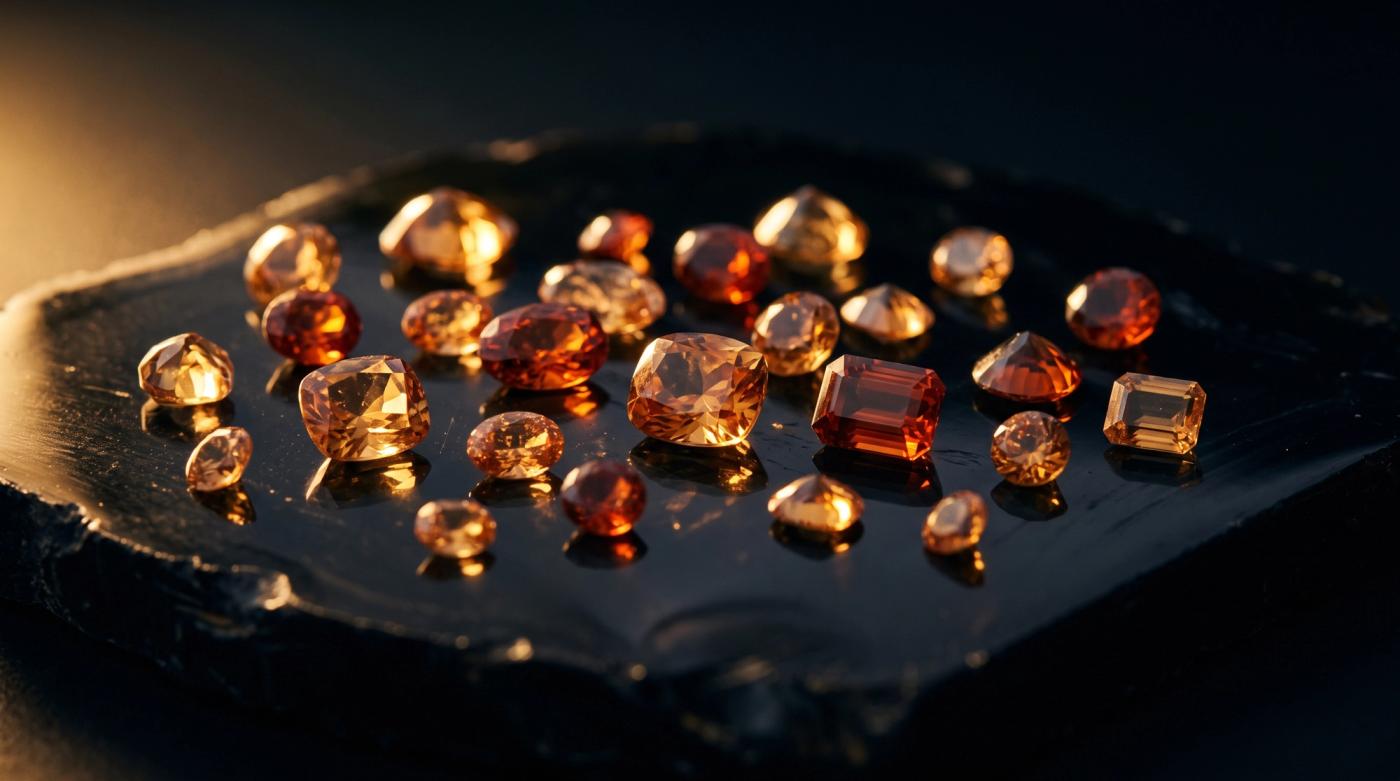
Hold a good piece of hessonite rough up to the light and you can see straight away why the old trade name stuck. It looks like a drop of set honey. Warm brown-orange, slightly cloudy, with something swirling inside it that never quite settles.
So what is hessonite garnet, exactly? It's a genuine garnet variety most people have never had explained properly — that's what this guide is for.
I've been buying rough in Sri Lanka for years, and hessonite is one of the stones I still enjoy picking through. It's cheap enough that nobody performs over it at the market, so you can take your time. And unlike a lot of what passes across that table, what you see in the rough is more or less what you get once the stone comes back from the cutter.
This is the guide I'd give a friend who'd just been told to buy one — whether that's for a ring, a collection, or because a priest handed them a piece of paper with the word Gomed written on it.
What Is Hessonite Garnet?
Hessonite is a variety of grossular garnet — one of the several distinct species that make up the garnet group. Grossular is a calcium aluminium silicate. Traces of iron (and, depending who you ask, manganese) push it into the honey-yellow, cinnamon-brown and orange-to-reddish-orange range that hessonite is known for.
So: is hessonite a garnet? Yes, completely. It isn't a garnet look-alike or a garnet substitute. It's a real member of the family, sitting in the grossular branch alongside the green vanadium-and-chromium-coloured tsavorite and the near-colourless leuco garnet.
The other trade name you'll see is cinnamon stone, which is the most honest description anyone has come up with for the colour.
A few practical properties of the hessonite garnet stone, as a dealer uses them:
- Hardness: roughly 6.5 to 7 on the Mohs scale. Hard enough for a ring you wear often, but not diamond-tough. It will scratch eventually if you're rough with it.
- Singly refractive. Garnet is isotropic — no double refraction, no facet doubling when you look through the crown with a loupe. That single fact rules out a few of the stones people confuse it with.
- Refractive index: in the region of 1.73–1.76 for grossular (hessonite specifically runs about 1.730–1.757), which is high enough to give a well-cut stone real snap.
- Rarely treated, with one exception. No established heat treatment improves hessonite the way heat improves sapphire. The one enhancement that does turn up is resin or polymer fracture-filling on heavily included, low-grade rough — I'll come back to it.
The name itself is usually explained as coming from a Greek word meaning inferior or lesser — a reference to it being softer and lighter than the garnets and zircons it was once confused with. I'd treat that etymology as the standard published story rather than something I can personally verify.
Hessonite vs Other Garnets
"Garnet" is not one stone. It's a group of related minerals with the same crystal structure and different chemistry, and the colour range across the whole group runs from near-colourless through green, orange, red, purple and black.
Here's how hessonite sits against the ones people mix it up with:
- Hessonite vs almandine/pyrope garnet — this is the "difference between garnet and hessonite" question most people are actually asking. When someone says "garnet" and pictures a dark wine-red stone, they mean almandine or pyrope. Those are iron- and magnesium-based species. Hessonite is grossular, calcium-based, and warm brown-orange. Different species, different chemistry, very different look.
- Hessonite vs spessartine — spessartine is the vivid orange garnet, and a fine one is a far more expensive stone. Spessartine tends to run cleaner and brighter orange; hessonite leans brown, honey and cinnamon, and usually carries much more visible internal texture.
- Hessonite vs tsavorite — same species (grossular), different colouring element, completely different price bracket.
About "black", "blue" and "red" hessonite
You'll see these listed online. Be careful.
True hessonite is honey to cinnamon to orange-brown. It is not black and it is not blue. Black garnet in the trade is generally melanite, a variety of andradite — a different species. Blue garnets do exist, but they're rare colour-change pyrope-spessartine material, not hessonite. And a deep red stone sold as "red hessonite" is far more likely to be almandine or a dyed imitation.
If a listing offers hessonite in five colours, it's a bead supplier using the word loosely, not a gemologist.
Where Hessonite Comes From (Sri Lanka's Gem-Bearing Regions)
Sri Lanka has been one of the best-known sources of gem-quality hessonite for a very long time, alongside Canada and Tanzania — the sources gemological references cite most consistently. It also turns up in smaller or lower-grade quantities in India, Madagascar and Brazil, among others — but Ceylon material has a reputation, and for hessonite that reputation is mostly deserved.
Most of what I see comes out of alluvial gravel — the gem-bearing layer local miners call illam, sitting under river valleys and paddy land across Sri Lanka's gem-bearing regions. The stones have been tumbled downstream and sorted by water over a very long time. That does two useful things: it rounds the rough into water-worn pebbles that are easy to read, and it destroys the badly fractured material along the way. What survives the river is generally worth cutting.
Hessonite is almost never the target of a dig. It comes up alongside sapphire, spinel and chrysoberyl in the same wash, and it gets set aside in a separate parcel. That's why it stays affordable. Supply isn't scarce.
What I look for in rough, in order:
- Colour saturation held up to light — a rich reddish-orange, not a washed-out tan.
- How much of the pebble is usable — hessonite rough often has a cloudier skin and a cleaner heart.
- Fracture lines — the one thing that genuinely kills a stone.
The rough almost always looks better than beginners expect and slightly worse than the finished stone. Cutting sharpens it. A pebble that reads as muddy brown in hand can come back from the wheel a clean cinnamon-orange, because the facets are finally letting light in and out cleanly instead of scattering it off a frosted surface.
How to Tell Real Hessonite From Fakes
This is where hessonite is unusually generous to the buyer, because hessonite garnet inclusions are close to a signature.
The treacle test — reading hessonite garnet inclusions
Look into a hessonite under a loupe, or even a bright phone torch. You should see a swirling, roiled, syrupy texture running through the stone — like honey being stirred into water, or heat rising off a road. The trade calls it a treacle or heat-wave effect. It's a growth texture, and it is extremely characteristic of hessonite.
Alongside it you'll often find small, well-formed transparent crystals sitting in the stone — apatite and zircon are commonly reported in hessonite. Under magnification they look like tiny rounded rods and grains.
Here's the point: in hessonite, that internal turbulence is a feature, not a fault. Buyers coming from the diamond world hear "included" and flinch. A hessonite with no treacle at all should make you more suspicious, not less.
Spotting glass and dyed material
Glass is the main imitation, and it turns up constantly in the astrology market where people are buying by name rather than by eye.
- Gas bubbles. Round, perfectly spherical bubbles mean glass. Natural garnet doesn't do that.
- Swirl marks and mould seams. Different from treacle — glass swirl looks like a stirred liquid frozen mid-motion, often with visible flow lines near the surface.
- Chips at the facet edges. Glass is soft and chips with a shell-shaped conchoidal break.
- Too perfect. A large, flawless, evenly coloured, cheap "hessonite" is almost always not hessonite.
- Colour concentrated in cracks. That's dye, and it's the classic tell in low-grade material sold cheaply for religious use.
The treatment point nobody makes
Hessonite is one of the few coloured stones on the market that is usually sold as it comes out of the ground — cut and polished, nothing else. There's no established heat treatment that improves it the way heat routinely improves sapphire. The one enhancement that does turn up in the trade is resin or polymer fracture-filling, used to stabilise heavily fractured, low-grade rough for cutting — a disclosed treatment, and not something you'll see on decent-quality material. If you want to understand how big a deal heat treatment is elsewhere in the trade, compare it with what heating does to corundum in our guide to heated versus unheated sapphire.
So if a seller is loudly advertising "natural untreated hessonite" at a premium, they're charging you for the ordinary state of the stone. What you actually need to verify is that it's hessonite at all, not glass or dyed quartz.
Hessonite Garnet Meaning & Symbolism
The hessonite garnet meaning people search for splits into two very different traditions, and it's worth keeping them separate.
In the Western gem tradition, hessonite is a garnet, and garnet is the birthstone for January. That's the simple answer to "which month is hessonite garnet the birthstone for."
Gomed in Vedic Astrology
In Vedic astrology, hessonite is known as Gomed (or Gomedhaka), and it's the stone associated with Rahu, the north lunar node. Practitioners of that tradition hold that wearing it can steady the influence of Rahu — and the claimed hessonite garnet benefits typically include mental clarity, focus, protection from confusion or ill intent, and relief from what's described as the disruptive side of Rahu's period.
I want to be straightforward here: I'm a gem dealer, not an astrologer. I'm reporting what the tradition holds. I don't make claims about health, money, or luck, and no honest seller should. If Gomed matters to you, take the astrological guidance from your own astrologer and take the gemology from someone who handles stones.
What I can tell you is that the Gomed market is where the worst material gets sold. People buy on faith, often quickly, often on a recommended carat weight, and dyed glass moves easily in that environment. If your reason for buying is religious, that is more reason to check the stone, not less.
Who Should Not Wear Hessonite, Which Finger, and How
Again — tradition, reported as tradition:
- The finger. Gomed is traditionally worn on the middle finger, usually set in silver or in the mixed metal panchdhatu, and traditionally first worn on a Saturday. Practices vary between astrologers and regions.
- Who should not wear it. Vedic astrology holds that Gomed is not suitable for everyone, and that suitability depends on the individual birth chart and ascendant rather than on a simple rule. Some traditions also advise against wearing it with certain other gemstones. There's no single agreed list, and anyone who gives you one flatly is oversimplifying. Ask an astrologer who has actually read your chart.
- A practical note from my side. The stone must touch the skin in most traditional settings, which means an open-back mounting. That leaves the pavilion exposed. At around 6.5 to 7 hardness, plan on cleaning it regularly and having the setting checked.
Hessonite Garnet Value & Price per Carat
Let's be plain: hessonite is an affordable gemstone. It isn't rare, it comes up as a by-product of mining for more valuable material, and it's available in large clean sizes. Under the old trade split of "precious" versus "semi-precious" — a classification the modern trade has largely abandoned as unhelpful — hessonite falls on the semi-precious side. Diamond, ruby, sapphire and emerald were the four "precious" stones.
Hessonite garnet price per carat varies enormously with quality, and I'd rather give you the drivers than a fake-precise number:
- Colour is most of the price. A vivid reddish-orange with real saturation sits at the top. Pale yellow-brown or muddy tan sits at the bottom, and the gap between them is several times over, not a few percent.
- Transparency second. Treacle is expected; opacity is not. You want a stone you can read print through, roughly speaking.
- Cut third, and it's badly underrated — see below.
- Size matters least. Because clean large hessonite exists, per-carat price doesn't climb as steeply with size as it does for sapphire or fine spinel.
Compared with fine Ceylon sapphire or good Ceylon spinel, hessonite trades in a completely different bracket — a fraction of the price for the same carat weight. Be wary of listings that price it like a rarity. And be equally wary of the cheapest tier online: at some point the price stops meaning "good value" and starts meaning "not hessonite."
Buying Guide: What to Look For
The mistake I see most often is buyers treating the word "Ceylon" as a quality grade. It isn't. It's an origin. There's beautiful Ceylon hessonite and there's dull, badly cut Ceylon hessonite coming out of the same gravel. Origin tells you where a stone is from — it doesn't tell you whether it's any good. (The same trap catches sapphire buyers, which we get into in what makes a Ceylon sapphire.)
What actually decides whether you're happy with the stone:
- Cut quality. This is the single biggest difference between two stones of the same colour and price. A hessonite cut for weight rather than beauty will have a window — a flat dead patch in the middle where light passes straight through instead of bouncing back. Tilt the stone. If the centre goes lifeless, walk away. The cutter I work with rejects far more rough for the way it would have to be cut than for its colour.
- Colour in real light. Look at it under daylight and under warm indoor light. Hessonite is a warm stone and it flatters itself under a shop's yellow lamps.
- Inclusions that reach the surface. Internal treacle is fine. A fracture that breaks the surface is a durability problem, especially in an open-back setting.
- Weight versus spread. Some cutters leave a deep pavilion to hold carat weight. You pay for grams you can't see. A well-proportioned stone often looks bigger face-up than a heavier one.
- A clear heated/unheated and origin statement. Even where treatment is uncommon, a seller should be willing to state it plainly. Every stone we list is labelled heated or unheated, with origin.
You can see the stones currently cut and in stock in our garnet collection, browse the full collection for everything else we're cutting right now, and if you want a specific colour or size that isn't listed, get in touch — parcels move, and what's on the site is only what's finished.
FAQ
Is hessonite a precious stone?
Under the traditional split, no — it's classed as semi-precious. That split is an old commercial convention, not a gemological one, and the trade increasingly ignores it. A superb hessonite beats a poor sapphire every day.
Is hessonite garnet expensive?
No, relative to the coloured-stone market as a whole. It's one of the better-value ways to own a genuinely attractive natural gemstone in a decent size.
What is hessonite garnet good for?
Practically: rings, pendants and earrings, at about 6.5 to 7 hardness. In the Vedic tradition, it's worn as Gomed, associated with Rahu — see the section above for how I'd handle that.
Can hessonite be scratched?
Yes, by anything harder — including quartz-based dust and sapphire. Store it separately from harder stones.
Does hessonite fade?
Its colour is from its chemistry, not a coating or dye, so genuine hessonite doesn't fade with normal wear. A stone that fades was dyed.
---
If I were telling a friend one thing, it'd be this: buy hessonite with your eyes, not with a certificate or a name. Hold it up. Look for the honey swirl inside — that's the stone telling you it's real. Then tilt it and check the middle stays alive. Colour and cut are the whole game here, and because the material is affordable, you can afford to be fussy. Most people buying hessonite settle for far less stone than their budget allows.
Ruchira K. is a licensed gem dealer in Sri Lanka and the founder of Grand Facets. The stones he sells are sourced locally and cut and polished by hand by the expert cutter he works with.
Comments
Be the first to leave a comment.
Thanks — your comment is in and will appear once we've approved it.