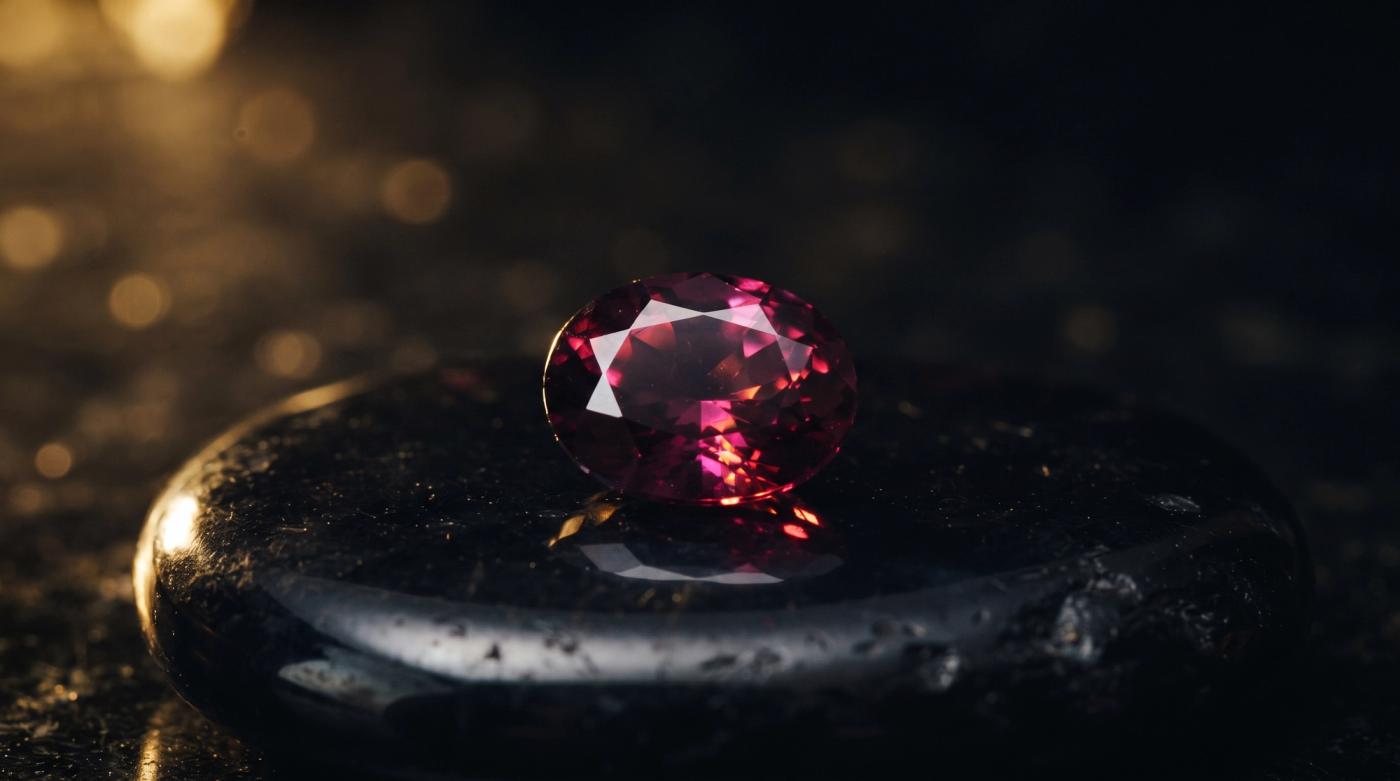
When I'm sorting through a parcel of rough at the gem market, most of what passes my hands is not sapphire. There's a lot of garnet in Sri Lankan gravel, and most of it I put straight back down. But every so often a piece catches the light with that raspberry-purple glow, and I stop. That colour is what tells me I might be holding rhodolite — and rhodolite is one of the few garnets I'll actually pay to have cut.
So let's talk honestly about rhodolite garnet value: what drives the price, what a good stone is really worth per carat, and how to tell whether the one in front of you is worth anything at all. I'll give you the same read I'd give a friend who showed me a stone across the counter.
What Is Rhodolite Garnet, Briefly
Rhodolite isn't a garnet species on its own. It's a natural blend — sitting between two garnet species, pyrope and almandine — and that mix is what gives it the raspberry to purplish-red colour it's known for. It's a real, natural garnet, full stop. Not a treated stone, not an imitation, not a "type" invented for marketing.
The name comes from the Greek for "rose stone," which fits — a good rhodolite leans rosy and bright rather than the dark, brownish red you see in common garnet.
If you want to see cut examples, our garnet collection shows the colour range better than any description can.
Rhodolite Garnet Value: Why It's Expensive (And When It Isn't)
Here's the honest answer most sales pages skip: rhodolite is not, by itself, an expensive gem. A dark, included, commercial-grade rhodolite is cheap. What you're paying a premium for is colour and cleanliness in the same stone — and that combination is genuinely uncommon.
A few things push a rhodolite's value up:
- Colour first, always. The bright raspberry and purplish-red stones command the premium. Once a stone drifts toward brownish, muddy, or too-dark red, the value drops fast — even if the stone is big and clean.
- It's usually eye-clean. Unlike a lot of coloured gems, good rhodolite tends to be free of visible inclusions. That's part of the appeal, but it also means an included rhodolite stands out for the wrong reasons and sells for less.
- Cutting makes or breaks it. A well-cut rhodolite lights up. A lazy cut leaves a "window" — a see-through dead zone in the middle where the colour leaks out instead of bouncing back at you. I've seen good rough ruined on the wheel, which is exactly why I only work with a cutter I trust.
- Bright, saturated colour is rarer than people think. For every clean, vivid stone, I see many more that are too dark or too brown to bother cutting.
So when someone asks why is rhodolite so expensive, the real answer is: the good stuff is expensive because bright, clean, well-cut colour is scarce. The ordinary material is not expensive at all.
Rhodolite Garnet Price Per Carat
Prices in the trade are quoted per carat, and they move with quality — not just size. Below are honest public reference ranges. Treat them as a map, not a fixed price list; every stone gets judged on its own.
Rhodolite garnet price per carat, by quality:
- Commercial grade (darker, included, or ordinary colour): roughly $20–$100 per carat
- Fine colour (bright raspberry/purplish-red, eye-clean, well-cut): roughly $200–$400 per carat
- Top / heirloom quality (vivid saturated colour, larger clean stones): up to around $1,000 per carat
A couple of things worth understanding about how this actually works:
- Price per carat rises with size. A clean, well-coloured 3-carat rhodolite is worth more per carat than the same quality at half a carat — because larger clean stones are rarer. So you can't just multiply a per-carat figure by the weight and expect a straight line.
- The gap between grades is huge. Two stones of the same weight can sit ten times apart in price purely on colour and cut. This is why "how much is rhodolite worth per carat" has no single answer.
What is a rhodolite garnet worth in the hand?
If a friend showed me a 1-carat rhodolite and asked what it's worth, I'd say: a plain, darkish one, maybe the price of a nice dinner. A bright, clean, well-cut one — comfortably into the hundreds. The colour is doing almost all the talking.
Is Rhodolite More Expensive Than Regular Garnet?
Usually, yes. Common red garnet — the everyday almandine you see in inexpensive jewellery — tends to be darker and more heavily included, and it sells for less. Rhodolite's brighter, more open colour puts it above ordinary garnet in most cases.
But "regular garnet" is a big family. Some garnets far outprice rhodolite — a fine tsavorite or a top demantoid (both green garnets) will leave rhodolite well behind. So rhodolite sits comfortably in the upper-middle of the garnet world: better than common red garnet, below the rare green ones.
(I'll write a full rhodolite-vs-garnet breakdown separately — it deserves its own piece.)
Is Rhodolite Garnet Rare?
Rhodolite is not rare as a mineral — garnet is common, and rhodolite is mined in several places, including Tanzania, Mozambique, Madagascar, parts of the United States, and Sri Lanka among others. Sri Lanka is a recognised source, but I'll be straight with you: it isn't the dominant source the way it is for sapphire. There's no famous "Ceylon rhodolite" category, and anyone selling you one is stretching the truth.
What is uncommon is fine-quality rhodolite — the bright, clean, well-cut stones. That's the honest version of "rare." The rough is around; the excellent finished stones are not.
Is It a Real, Natural Garnet? Is It a Ruby?
Yes, rhodolite is a genuine, natural garnet. And no, it is not a ruby — that's a common mix-up because both can be red. Ruby is corundum, far harder and, at gem quality, far more valuable. A red garnet and a ruby can look similar to the eye, but they're completely different minerals. If someone's selling a "ruby" cheaply, red garnet is one of the things it might really be.
Is rhodolite ever treated?
Here's a point I genuinely like about rhodolite: it's rarely heat-treated. Most rhodolite on the market is exactly what nature made — no heat, no enhancement. That's not something I can say about a lot of stones (sapphire, for one, is routinely heated). At Grand Facets every stone is labelled heated or unheated, and with rhodolite the honest label is almost always simply natural, untreated. It's one of the cleaner corners of the coloured-stone trade for a buyer who wants no surprises.
How to Tell If a Rhodolite Garnet Is Real
You won't confirm it fully without a lab, but here's what I actually look at across the counter:
- Look for tiny natural inclusions. A stone that is perfectly, uniformly flawless with dead-even colour, especially at a suspiciously low price, makes me want a second look — glass and synthetics can look too clean and too even.
- Colour should have life and slight variation, not a flat, painted look.
- Garnet is singly refractive — a gemmologist checking under a loupe and polariscope can separate it from lookalikes quickly.
- Ask about the source and treatment, and expect a straight answer. A dealer who can tell you where it came from and whether it's heated is worth more than one who can't.
If it's a significant stone, get an independent report from a recognised lab. For everyday rhodolite, a trustworthy dealer and your own eye go a long way.
Rhodolite Hardness — Does It Hold Up?
Rhodolite sits around 7 to 7.5 on the Mohs scale. That's durable enough for rings, earrings and pendants with normal care — harder than quartz, a touch below sapphire. I wouldn't treat it recklessly, but rhodolite is a practical everyday stone, not a fragile collector-only gem.
What I'd Tell a Friend
If you're buying rhodolite, spend your money on colour and cut, not carat weight. A bright, lively, well-cut one-carat stone will please you far longer than a big, dark, windowed three-carat one that cost the same. Hold it under a few different lights. If the middle goes see-through or the red turns brown, walk away. And because rhodolite is almost always natural and untreated, you're not paying for treatment you can't see — you're paying for honest colour. That's a fair trade.
When a good one comes back from the cutter and throws that raspberry flash across the table, you understand exactly why the fine stones cost what they do.
Browse what we currently have cut in our garnet collection, or see the full range of stones across the whole collection.
FAQ
What is a rhodolite garnet worth?
Anywhere from about $20 per carat for ordinary commercial stones up to around $1,000 per carat for top heirloom-quality colour. Most good, bright, clean stones land in the $200–$400 per carat range.
Why is rhodolite so expensive?
The fine material isn't common — bright raspberry-to-purplish colour, eye-clean, and well cut, all in one stone. Ordinary rhodolite is actually inexpensive; you're paying for that rare combination of colour and cleanliness.
How much is rhodolite per carat?
Roughly $20–$100/ct commercial, $200–$400/ct for fine colour, and up to about $1,000/ct for the very best. Price per carat also rises with size for clean stones.
Is rhodolite more expensive than regular garnet?
Usually yes — it outprices common dark red garnet. But rare green garnets like tsavorite and demantoid cost far more than rhodolite.
Is rhodolite garnet a real, natural garnet?
Yes. It's a natural garnet, a blend of the pyrope and almandine species, and it's rarely treated in any way.
Is rhodolite garnet a ruby?
No. Both can be red, but ruby is corundum — a different, harder, and generally more valuable mineral.
Is rhodolite garnet rare?
The mineral isn't rare, but fine-quality stones with vivid clean colour genuinely are.
How hard is rhodolite garnet?
About 7 to 7.5 on the Mohs scale — durable enough for everyday jewellery with reasonable care.
Written from the counter, not the marketing desk. At Grand Facets we sell natural Ceylon gemstones, each labelled heated or unheated, cut and polished by hand by the expert cutter I work with. If you're weighing up a rhodolite, judge the colour and the cut first — the rest follows.
Comments
Be the first to leave a comment.
Thanks — your comment is in and will appear once we've approved it.