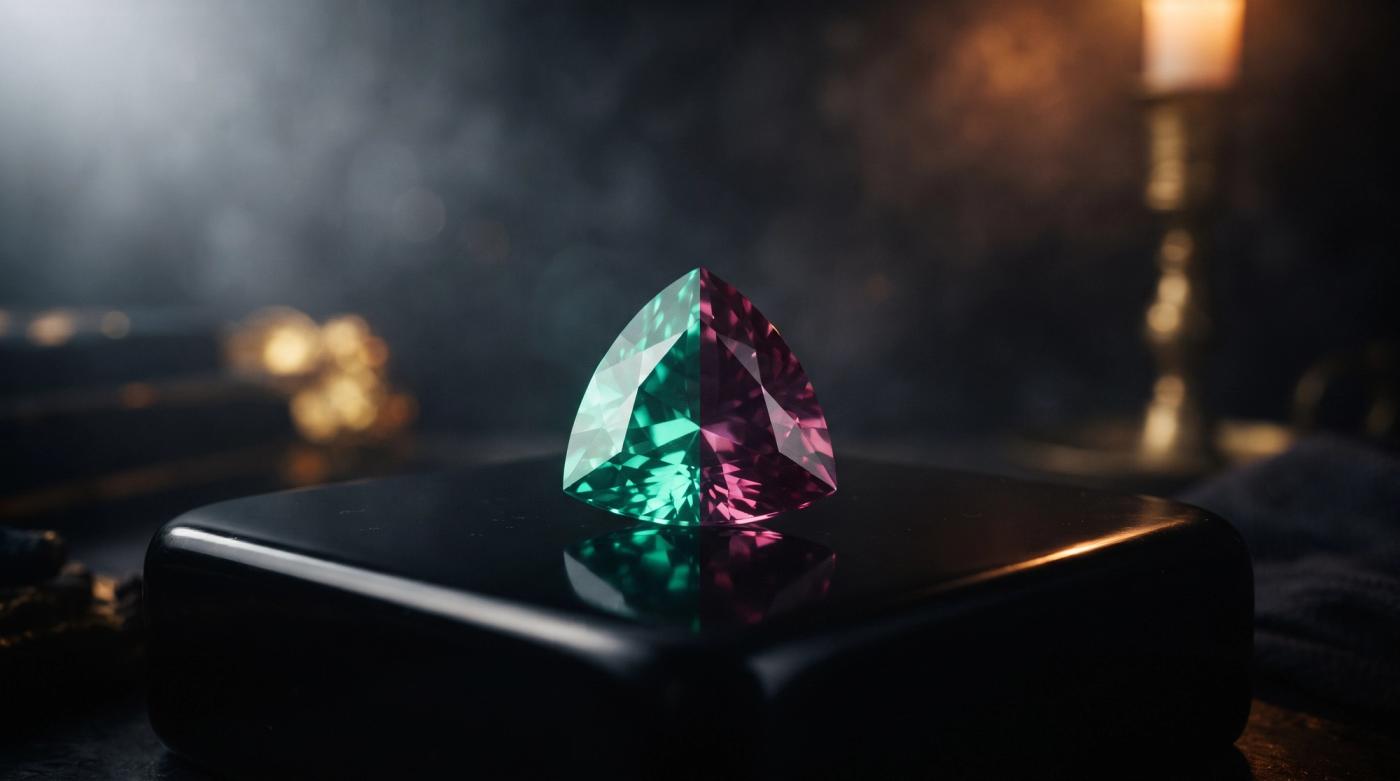
Alexandrite is the one stone that has fooled me twice at the market — and I deal in gems for a living. Both times it wasn't really a fake meant to cheat me. It was a colour-change sapphire sitting in a parcel of mixed rough, and in the wrong light it teased me with that green-to-red flip. I bought one anyway, had it cut by the expert cutter I work with, and it turned out exactly what I suspected: a fine colour-change sapphire, not alexandrite. That mix-up is the whole reason this guide exists.
So let's sort out real vs fake alexandrite properly — because "fake" is a lazy word that covers three very different things, and knowing which one you're holding changes everything about what it's worth.
First, what real alexandrite actually is
Alexandrite is the colour-change variety of chrysoberyl. Same mineral family as the cat's eye chrysoberyl that passes through my hands fairly often. What makes alexandrite special is trace chromium in the crystal, which makes the stone shift colour depending on the light hitting it.
The classic description is "emerald by day, ruby by night." In real life that's a little generous. What you're actually looking for:
- Daylight or white LED: green, bluish-green, or greyish-green.
- Incandescent light, candle, or warm bulb: red, purplish-red, or brownish-red.
That flip is called the alexandrite effect, and true, sharp colour change is rare and expensive. Most natural alexandrite shows a partial or muddy change, not the storybook version.
Real alexandrite is a genuinely scarce stone. It's found in a handful of places — Russia's Ural Mountains (the original source), Brazil, East Africa, and yes, Sri Lanka. I'll come back to the Ceylon material, because that's where I work and where the local confusion runs deepest.
The two-bucket rule: real vs fake alexandrite
Before any testing, get this framework straight. Almost every argument I hear at the market comes from people blurring these two things:
Bucket A — Synthetic (lab-grown) alexandrite. This is real chrysoberyl with real colour change, grown in a lab instead of the ground. Chemically and optically it's alexandrite. It is not a scam by itself — plenty of honest sellers label it clearly. The only problem is when someone sells lab-grown at natural prices. It's a pricing and disclosure issue, not a "this isn't alexandrite" issue.
Bucket B — Simulants. These are completely different minerals that only look like alexandrite. Colour-change sapphire, colour-change garnet, and lab-made corundum doped with vanadium (often sold as "alexandrite" or "alexandrite-like"). They change colour, so they fool the eye, but they are the wrong stone entirely.
Keep those buckets separate in your head and half the confusion disappears. A synthetic alexandrite is still alexandrite. A colour-change sapphire is not — no matter what the seller calls it.
How to check yours — the testable steps
Here's the order I'd actually go through, roughly what I do at the table when a stone lands in front of me. None of this replaces a lab report, but it tells you fast whether a stone deserves one.
1. The two-light colour-change test
This is the single most useful check and you can do it at home.
- Take the stone into daylight (near a window, not direct sun) or under a cool white LED. Note the colour.
- Now move it under a warm incandescent bulb, or an old-style filament torch, or even a candle. Note the colour again.
Real alexandrite shifts between a green family and a red family. If your stone goes from blue to purple, that's the classic tell of a colour-change sapphire, not alexandrite — though a small minority of colour-change sapphires shift green-to-red too (sometimes sold as "alexandrite-type sapphire"), so a green-red shift alone is a strong clue, not proof of species. If it changes from grey to a weak pinkish tone, or barely shifts at all, be sceptical — but remember weak change can also just mean lower-grade real alexandrite.
One warning from experience: your phone flashlight and modern LED bulbs are "cool" light. If you only ever look under one light source, you'll never see the change. You need two genuinely different light temperatures.
2. Loupe and inclusions
Under a 10x loupe, natural and synthetic stones tend to tell on themselves.
- Natural alexandrite usually carries fingerprints, fine silk, or small crystal inclusions — the messy signature of growing in the earth. Some natural stones also show a strong cat's-eye or even a rare colour-change cat's-eye.
- Lab-grown alexandrite often looks too clean, or shows curved growth lines and sometimes tiny gas bubbles (a hallmark of certain synthetic growth methods).
- Glass and doublet simulants show rounded gas bubbles and swirl marks.
I won't pretend inclusion reading is a beginner skill. It takes years at the loupe. But bubbles in a "natural" stone are a red flag anyone can learn to spot.
3. UV response
Under longwave UV, alexandrite with strong chromium can show a red glow, and some synthetics fluoresce more strongly and cleanly than natural stones. On its own, UV is not a decider — it's a supporting clue, not proof. Don't let anyone tell you a single UV reaction settles it.
4. The price sanity-check
This one catches more fakes than any loupe.
Fine natural alexandrite in good sizes is one of the most expensive coloured stones on earth — it competes with top sapphire and ruby per carat. So if someone offers you a clean, 2-carat stone with a dramatic colour change for the price of a night out, the maths is telling you something. Either it's synthetic, it's a simulant, or the "colour change" is being oversold. Real, sharp, untreated alexandrite in larger sizes simply does not turn up cheap.
The Ceylon angle: alexandrite in the Sri Lankan trade
Sri Lanka does produce alexandrite — the finds come mostly from the Ratnapura, Rakwana, and Balangoda areas, out of the same alluvial illam gravels that give us sapphire, spinel, and chrysoberyl. It's rare here. In years of picking through rough, genuine alexandrite crosses my table far less often than colour-change sapphire does.
And that's exactly where the local confusion lives. Ceylon is famous for colour-change sapphire — blue-to-purple, sometimes greenish shifts — and to an untrained eye at a market stall, a colour-change sapphire and an alexandrite can look like cousins. I've watched buyers pay alexandrite hopes for a sapphire reality. The stones are both beautiful; they are not the same value, and they are not the same mineral.
When alexandrite genuinely passes through my hands, the rough itself gives hints before it ever reaches my cutter's wheel — the way the colour behaves as I roll it toward and away from the window. But even I send anything serious to a lab. Which is the honest bottom line: eyes and a loupe get you close, paper gets you certainty.
You can see the kinds of Ceylon stones I do work with regularly across the sapphire, spinel, and chrysoberyl collections — including the colour-change sapphires that get mistaken for alexandrite in the first place.
What makes real alexandrite valuable
If you're weighing a purchase, value tracks four things:
- Strength of colour change. A full, clean green-to-red flip is the whole game. Weak or partial change drops the price hard.
- Colour quality. Vivid green and a strong red beat greyish or brownish tones.
- Clarity and size. Clean stones over a carat are scarce, so price climbs steeply with size.
- Origin and treatment. Fine untreated material, with a respected lab report, sits at the top.
Quick FAQ
How do you test alexandrite at home?
Use the two-light test: cool daylight or white LED versus a warm incandescent bulb. Real alexandrite usually shifts green-to-red. Blue-to-purple usually points to colour-change sapphire — but a rare colour-change sapphire can also shift green-to-red, so colour change narrows it down, it doesn't confirm the species on its own.
Do lab-grown and synthetic alexandrite still change colour?
Yes. Synthetic alexandrite is real chrysoberyl grown in a lab, so it shows genuine colour change — often very cleanly. Colour change alone never proves a stone is natural.
Is synthetic alexandrite worth anything?
It has value as an affordable, attractive stone, but far below natural. The issue is never that it's "worthless" — it's that it should be sold and priced as synthetic, not passed off as natural.
What does a fake alexandrite look like?
Depends which "fake." A simulant like colour-change sapphire or garnet changes colour but shifts through the wrong colours (often blue-to-purple). Glass imitations show gas bubbles and swirls under a loupe.
How is alexandrite different from colour-change sapphire?
Different mineral (chrysoberyl vs corundum) and usually a different colour shift — alexandrite goes green-to-red, colour-change sapphire commonly goes blue-to-purple. Sapphire is also more common and generally less costly than fine alexandrite.
How much does a 1-carat alexandrite cost?
It varies enormously with the strength of the colour change and clarity, so I won't quote a single number — but fine natural alexandrite is among the priciest coloured stones per carat, well above most sapphire. A cheap "1-carat alexandrite" is a warning sign, not a bargain. Get any serious stone to a lab for a report.
Is my alexandrite real?
Run the two-light test and the price sanity-check first. If both pass and the stone matters to you, send it to a recognised lab. That's the only way to be sure.
What I'd tell a friend
Three things, in order:
- Look under two different lights — no change, or a blue-to-purple change, means think again.
- Let the price talk. Cheap plus dramatic colour change almost always means synthetic or simulant.
- For anything serious, get a lab report. GIA, SSEF, Gübelin — a stone worth real money is worth the paper.
None of this is about fear. Synthetic alexandrite is a fine stone when it's sold honestly, and a good colour-change sapphire is beautiful in its own right. The only thing that turns any of them into a "fake" is a seller pretending it's something it isn't.
At Grand Facets I label every stone plainly — natural, Sri Lankan, and clearly marked heated or unheated — and I back the serious ones with lab reports rather than my word. If you want to see how that looks in practice, browse the full collection. And if you're ever unsure about a stone, ask before you buy. That's the whole trade, really: knowing what you're holding.
Comments
Be the first to leave a comment.
Thanks — your comment is in and will appear once we've approved it.