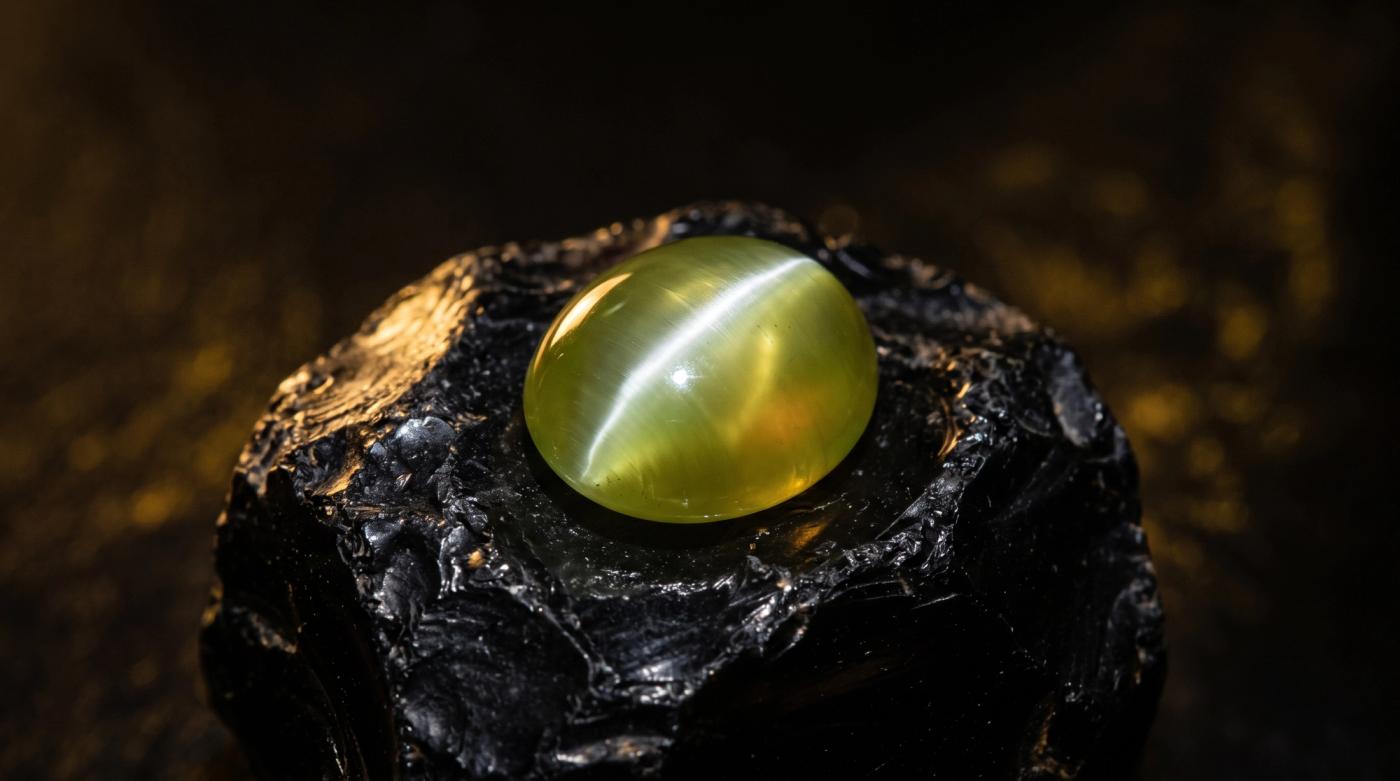
The first time you see a good cat's eye move, you don't forget it. I roll the cabochon slowly under a single light and a thin silver line slides across the dome like the shutter of an eye opening and closing. That line is the whole reason this stone exists in the trade, and getting it to sit dead centre is the hardest part of my work at the wheel.
I buy rough chrysoberyl at the markets in Ratnapura and Beruwala, cut and polish it by hand, and sell the finished stones. So this isn't a guide written from a textbook. It's what I actually look for in a parcel, how I orient the eye when I cut, and the one simple test I use to catch a quartz cat's eye being passed off as chrysoberyl.
What Is a Chrysoberyl Cat's Eye Gemstone?
Chrysoberyl is a mineral in its own right — beryllium aluminium oxide. Despite the name, it has nothing to do with beryl (emerald, aquamarine). The cat's eye variety has a specific old name too: cymophane.
The eye effect is called chatoyancy. It comes from millions of microscopic parallel tubes or needle-like inclusions running in one direction through the stone. When I cut the rough as a dome (a cabochon) with those needles lying flat under the surface, light reflects off them as a single bright band at ninety degrees to their direction. Move the light, and the band moves. That's the eye.
The best chrysoberyl cat's eyes show something called the milk and honey effect. Shine a light from one side and half the dome looks like golden honey while the other half turns milky white, split right down the eye. When I'm sorting rough, a stone that promises milk and honey is the one I hold back from the bulk pile.
One point of language that trips buyers up: in the gem trade, "cat's eye" on its own means chrysoberyl. Nothing else. Every other chatoyant stone has to carry its full name — quartz cat's eye, tourmaline cat's eye, apatite cat's eye. If a seller just says "cat's eye" and shows you something suspiciously cheap and large, that's the first thing worth questioning.
Why Sri Lanka's Chrysoberyl Cat's Eye Is Considered the World's Best
Chrysoberyl turns up in Brazil, India, Madagascar and Tanzania, but the finest cat's eyes have long come from here in Sri Lanka. Our stones come out of the alluvial gravel beds we call illam — gem-bearing layers left by ancient rivers, mostly worked around Ratnapura and Elahera.
What Ceylon material gives you, more often than other sources, is that combination of a clean honey-gold or greenish-gold body colour with a sharp, tight eye. Plenty of rough has the eye but muddy colour, or good colour with a lazy, broad eye. Getting both in one stone is what makes Sri Lankan cat's eye sit at the top of the market. The classic prized colour is a warm honey to golden yellow, sometimes leaning apple-green. If you want a measure of how far Ceylon material goes, the Smithsonian's national gem collection holds a Sri Lankan cat's eye chrysoberyl of around 171 carats.
You'll notice I keep coming back to Ratnapura. The name means "city of gems," and the trade there runs on parcels of washed gravel changing hands at the market. Chrysoberyl is heavy and durable, so it survives in the gravel well and shows up alongside Ceylon sapphire and spinel in the same washes.
From Rough to Cabochon: How the Eye Is Actually Cut
This is the part no textbook shows you, so let me walk through what actually happens on my bench.
Reading the rough. When I pick up a piece of rough chrysoberyl, the first thing I do is wet it and hold it to a bright point of light, turning it. I'm hunting for the sheen — a faint moving glow inside that tells me the needles are there and, crucially, which direction they run. In good cat's eye rough that sheen is obvious. In weak material it's patchy, meaning the eye will be broken or off-centre no matter what I do.
Orienting the stone. The whole trick is this: the base of the finished cabochon must sit parallel to the direction of the needles, and the dome's long axis must run along them. Get that right and the eye lands as a single sharp line straight across the top. Get it wrong — even by a small angle — and the eye sits diagonal, or splits, or slides off to one edge. Once I've decided the orientation, I mark it and grind the flat base first, because the base fixes everything after it. This is where value is won or lost. A stone cut for maximum weight instead of a centred eye is worth a fraction of one cut properly.
Doming and polishing. I grind the dome high and rounded, not flat. A higher dome tightens the eye into a crisper line; too flat and it spreads and goes dull. The height is a judgement call for each stone. Then it's onto the polishing lap, and because chrysoberyl is so hard, this stage is slow. That hardness is a blessing in the finished stone and a test of patience at the wheel.
The honest part: you lose weight to get the eye right, and sometimes the rough that looked perfect hides a flaw that only shows once the dome is up. That's the gamble every cutter takes with each piece.
Real Chrysoberyl vs. Quartz Cat's Eye: How to Tell the Difference
This is where buyers get caught. Quartz cat's eye is a real, natural stone — but it's common and cheap, and it gets sold as chrysoberyl to people who don't know the tells. Here's how I separate them.
- The eye itself. Chrysoberyl gives a sharp, bright, almost silvery eye on a translucent body — this is the milk-and-honey stone. Quartz gives a softer, broader, whiter band on a more glassy, see-through body. Once you've seen both side by side, the quartz eye looks lazy.
- Body colour. Chrysoberyl cat's eye runs honey, gold, greenish-gold, sometimes brownish. Quartz cat's eye is often greyish, greenish, or a washed-out yellow with a glassy look you can see deeper into.
- Size and price for the money. If someone offers you a big, clean cat's eye for a small price, be suspicious. Chrysoberyl in large clean sizes is expensive. A cheap 10-carat "cat's eye" is almost always quartz.
- Weight in the hand. Chrysoberyl is noticeably denser than quartz. Two stones the same size — the chrysoberyl feels heavier. It's subtle, but with practice you feel it.
The one concrete test I trust: hardness and heft together. Chrysoberyl is 8.5 on the Mohs scale — one of the hardest gems there is, behind only diamond and corundum (sapphire and ruby). Quartz is 7. And chrysoberyl's refractive index (around 1.74–1.75) is well above quartz (around 1.54), which is a big reason its eye reads sharper and brighter. I'm not asking you to scratch a stone in a shop. What I'm telling you is: a sharp, bright, silvery eye + real heft in the hand + a price that reflects rarity = chrysoberyl. A soft, broad eye + light, glassy stone + a bargain price = quartz. For any serious purchase, ask for a report from a proper lab — GIA or a recognised gem lab — that names the species outright. The word "chrysoberyl" should appear on paper.
How Much Is Chrysoberyl Cat's Eye Worth?
Price depends on the stone, not a fixed rate, but the drivers are consistent. From most to least important:
- Sharpness and centring of the eye — a knife-sharp line dead centre is everything.
- The milk-and-honey effect — a clean split lifts value sharply.
- Body colour — warm honey to golden, or fine greenish-gold, sits above muddy brown.
- Size — clean large stones are rare and the price per carat climbs with size.
- Clarity and finish — a clean dome with no distracting flaws under the eye.
As a rough guide: ordinary commercial cat's eyes with a weak eye can be modest, often in the tens to low hundreds of dollars per carat. Good stones with a strong centred eye and honey colour run into the hundreds per carat, and top gems — sharp eye, clean milk and honey, fine colour, larger size — reach well into the thousands per carat. Treat those as ballpark ranges; the market moves, every stone is judged on its own face, and no lab publishes an official price guide — this reflects current trade pricing, not a certified value.
Who Traditionally Avoids Wearing Cat's Eye?
This comes up a lot, so here it is briefly and respectfully. In Vedic (Indian) astrology, cat's eye — called Lehsunia or Vaidurya — is the gem linked to Ketu, one of the two lunar nodes. Tradition holds that it's worn to strengthen Ketu, and the common advice is that it should only be worn after consulting an astrologer, because a stone tied to a strong or well-placed planet in your chart may not suit you. Some traditions caution against wearing it casually or alongside certain other gemstones.
I sell stones, not astrological advice, so I'll leave it there: if you're buying for astrological reasons, talk to someone qualified in that field. If you're buying for the beauty of the eye, none of this need concern you.
Buying a Chrysoberyl Cat's Eye: What I'd Tell a Friend
- Look at the eye under a single light, and move the light. It should be one sharp band that glides cleanly. Broken, wavy or off-centre eyes are worth far less.
- Check the eye is centred on the dome, not slid to one side.
- Ask heated or unheated, and ask the origin. (Fine cat's eye is usually not heat-treated, but always ask.) Every stone I sell is labelled that way.
- For anything serious, get a lab report that states "chrysoberyl" — that alone rules out the quartz swap.
- Don't chase a bargain on a big clean stone. In cat's eye, cheap and large usually means quartz.
That's the honest version of how this stone works, from the market gravel to the finished dome. If you want to see hand-cut Ceylon stones, our loose chrysoberyl and the wider collection are there to browse — every one labelled for treatment and origin, cut on the same wheel I've described here.
Comments
Be the first to leave a comment.
Thanks — your comment is in and will appear once we've approved it.